Action Classes in Laravel: One Class Per Operation, Called From Anywhere
How I write action classes in Laravel 12, why I keep them as plain classes with one handle method, and how the same action gets called from a controller, a Filament action, a Livewire component and a queued job.

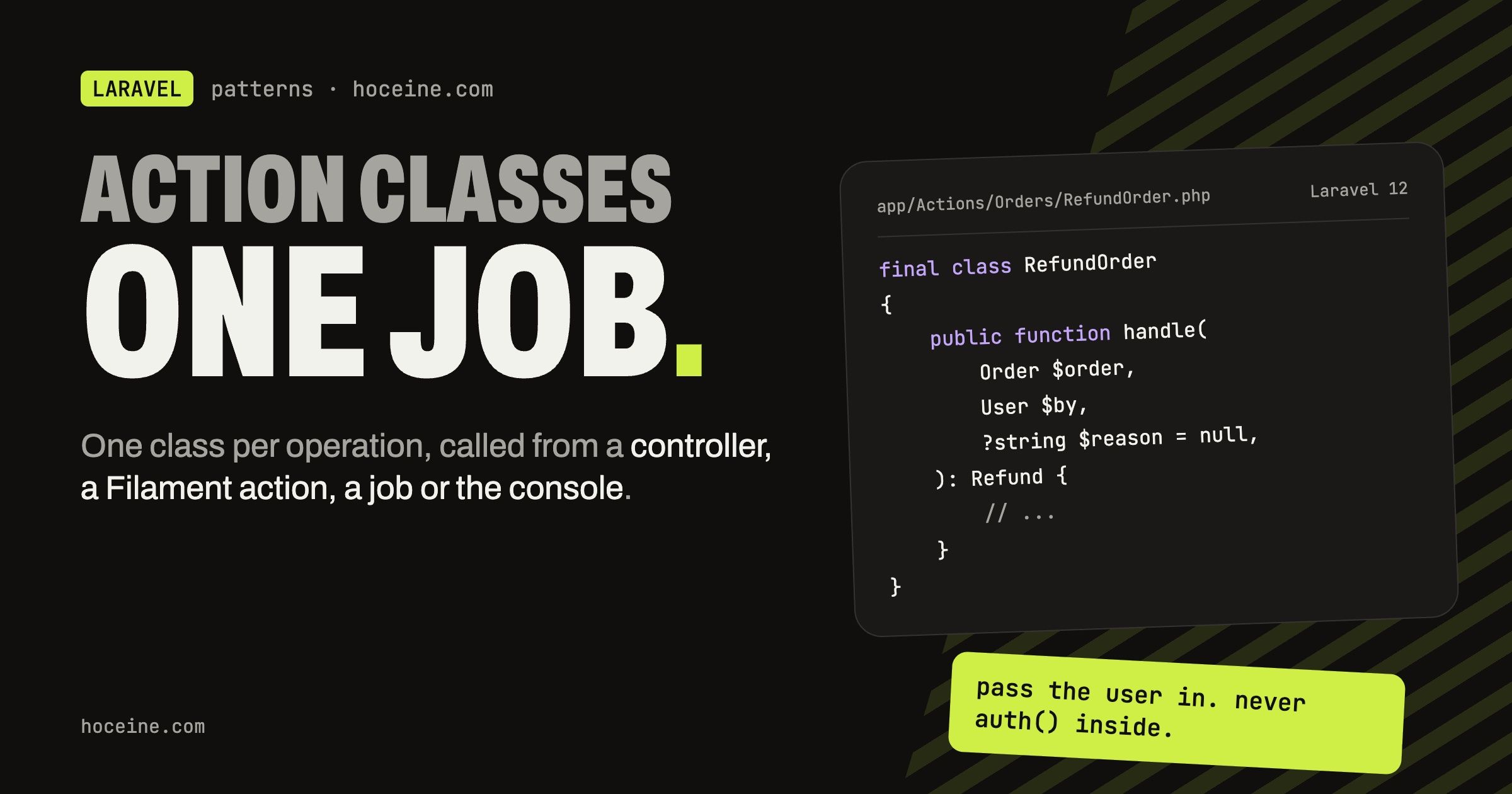
Action Classes in Laravel
A lot of business logic gets triggered from more than one place. A refund starts from a button in the Filament panel, but it also has to run from an API endpoint, from a support tool built in Livewire, and sometimes from an Artisan command when a payment provider sends a batch of disputes. If the refund logic lives in a controller method, every other entry point either copies it or calls the controller, and both are bad.
An action class fixes that. It is a class that does one operation, takes its inputs as arguments, and gets its dependencies from the container. Every entry point becomes a thin adapter that collects input and calls it.
This post is my take on how to write them. It is opinionated, and some of it disagrees with how actions are usually shown.
What an action is, and what it is not
An action is one business operation, named as a verb: RefundOrder, InviteTeamMember,
PublishPage. It is not a wrapper around a single Eloquent call. UpdateUserName that runs
$user->update(['name' => $name]) is a class for the sake of a class. If the operation is a
model update with validation and nothing else, the Filament resource or the form request
already handles it fine.
The test I use: does this operation touch more than one model, call an outside service, fire side effects, or need to run from more than one entry point? If yes, it gets an action. If no, it stays where it is.
The shape I use
No package, no base class, no interface. One public method called handle:
namespace App\Actions\Orders;

use App\Enums\OrderStatus;
use App\Events\OrderRefunded;
use App\Exceptions\OrderNotRefundable;
use App\Models\Order;
use App\Models\Refund;
use App\Models\User;
use App\Services\Payments\PaymentGateway;
use Illuminate\Support\Facades\DB;

final class RefundOrder
{
    public function __construct(
        private PaymentGateway $gateway,
    ) {}

    public function handle(Order $order, User $by, ?string $reason = null): Refund
    {
        if (! $order->status->isRefundable()) {
            throw OrderNotRefundable::for($order);
        }

        $providerRefund = $this->gateway->refund($order->payment_reference, $order->total);

        $refund = DB::transaction(function () use ($order, $by, $reason, $providerRefund) {
            $refund = $order->refunds()->create([
                'amount' => $order->total,
                'provider_id' => $providerRefund->id,
                'reason' => $reason,
                'refunded_by' => $by->id,
            ]);

            $order->update(['status' => OrderStatus::Refunded]);

            return $refund;
        });

        OrderRefunded::dispatch($order, $refund);

        return $refund;
    }
}
A few choices in there that I hold to:
handle, not__invokeorexecute. It reads the same as jobs and listeners, and$refund->handle(...)is clearer at the call site than($refund)(...). The name itself matters less than using one name across the whole codebase.- Explicit arguments, not an array.
handle(Order $order, User $by, ?string $reason)tells you what the operation needs.handle(array $data)tells you nothing, and static analysis can't help you. When the argument list gets long, I pass a small readonly data object instead. - The acting user is an argument. The action does not call
auth()->user(). When this runs from a queued job or a console command there is no authenticated user, and an action that reads the session quietly breaks there. - Authorization stays outside. The controller or the Filament action checks the policy. The action enforces business rules ("this order is not refundable") and throws a domain exception when they fail. A console command run by an admin should not need to fake a logged-in user to pass a policy check.
- The external call happens before the transaction. Holding a database transaction open while you wait on a payment provider is how you get lock timeouts. Call the provider, then write everything in one short transaction.
Calling it from a controller
The controller does HTTP things: authorize, validate, call, respond.
public function store(RefundRequest $request, Order $order, RefundOrder $refundOrder)
{
    $this->authorize('refund', $order);

    $refund = $refundOrder->handle($order, $request->user(), $request->validated('reason'));

    return new RefundResource($refund);
}
Laravel resolves RefundOrder from the container, which builds the PaymentGateway for it.
Calling it from a Filament action
This is where actions earn their keep for me, because most of my work is Filament panels. A Filament table or page action is already a small adapter: it renders a button, maybe a modal form, and runs a closure. The closure is the right place to call the action and nothing more.
In Filament 4 actions live under Filament\Actions\Action, and the closure gets $record and
the modal form $data injected by name:
use App\Actions\Orders\RefundOrder;
use App\Exceptions\OrderNotRefundable;
use App\Models\Order;
use Filament\Actions\Action;
use Filament\Forms\Components\Textarea;
use Filament\Notifications\Notification;

Action::make('refund')
    ->requiresConfirmation()
    ->schema([
        Textarea::make('reason')->maxLength(500),
    ])
    ->visible(fn (Order $record): bool => auth()->user()->can('refund', $record))
    ->action(function (Order $record, array $data): void {
        try {
            resolve(RefundOrder::class)->handle($record, auth()->user(), $data['reason']);
        } catch (OrderNotRefundable $e) {
            Notification::make()->title($e->getMessage())->danger()->send();

            return;
        }

        Notification::make()->title('Order refunded')->success()->send();
    });
Two things I like about this split. The Filament code only deals with Filament concerns:
visibility, the modal, the notification. And when the same refund button is needed as a bulk
action, the bulk action loops over the records and calls the same handle. Nothing gets
copied into a second closure.
The version I see often, and avoid, puts thirty lines of refund logic directly in the
->action() closure. It works until someone needs the refund from an API, and then that logic
is trapped inside a resource class.
Calling it from a Livewire component
Livewire 3 resolves type-hinted dependencies on action methods, so a component method can take the action as a parameter the same way a controller does:
use App\Actions\Orders\RefundOrder;
use App\Exceptions\OrderNotRefundable;
use App\Models\Order;
use Livewire\Attributes\Validate;
use Livewire\Component;

class OrderSupportPanel extends Component
{
    public Order $order;

    #[Validate('nullable|string|max:500')]
    public string $reason = '';

    public function refund(RefundOrder $refundOrder): void
    {
        $this->authorize('refund', $this->order);
        $this->validate();

        try {
            $refundOrder->handle($this->order, auth()->user(), $this->reason ?: null);
        } catch (OrderNotRefundable $e) {
            $this->addError('reason', $e->getMessage());

            return;
        }

        $this->dispatch('order-refunded');
    }
}
Same pattern again: the component owns state, validation, and what the UI shows on failure. The action owns the operation.
Queueing: wrap the action in a job
A pattern I have seen in tutorials is to mark the action itself ShouldQueue and call it
directly. That does nothing. ShouldQueue only matters when a class is dispatched through the
bus as a job, or registered as an event listener. Calling ->handle() on an object runs it
right there, queue marker or not.
When the operation needs to run in the background, write a job that calls the action:
namespace App\Jobs;

use App\Actions\Orders\RefundOrder;
use App\Models\Order;
use App\Models\User;
use Illuminate\Contracts\Queue\ShouldQueue;
use Illuminate\Foundation\Queue\Queueable;

class RefundOrderJob implements ShouldQueue
{
    use Queueable;

    public int $tries = 3;

    public function __construct(
        public Order $order,
        public User $by,
        public ?string $reason = null,
    ) {}

    public function handle(RefundOrder $refundOrder): void
    {
        $refundOrder->handle($this->order, $this->by, $this->reason);
    }
}
Job handle methods get dependencies injected by the container, so the action comes in as a
parameter. The job owns queue concerns (tries, backoff, uniqueness), the action owns the
business rule. This is also where passing the user explicitly pays off: the job has no session,
and the action never needed one.
If you would rather have one class that can be a controller, a job, a listener and a command, lorisleiva/laravel-actions does that. I've chosen not to use it, because I find two small explicit classes easier to read than one class that changes role depending on how it was called. That is a preference, not a flaw in the package.
Composing actions
Actions can call other actions through the constructor:
final class CancelSubscription
{
    public function __construct(
        private RefundOrder $refundOrder,
        private RevokeAccess $revokeAccess,
    ) {}

    public function handle(Subscription $subscription, User $by): void
    {
        if ($subscription->latestOrder->isWithinRefundWindow()) {
            $this->refundOrder->handle($subscription->latestOrder, $by, 'Cancelled in refund window');
        }

        $this->revokeAccess->handle($subscription->team);

        $subscription->markCancelled();
    }
}
I keep this to one level. When an action calls an action that calls an action, it becomes hard to see where a transaction starts and which events fire, and it usually means the top-level action is really a workflow that wants to be a job chain or a batch.
Testing
Actions are easy to test because they are plain classes. With Pest, I resolve the action from the container and swap the external dependency:
use App\Actions\Orders\RefundOrder;
use App\Enums\OrderStatus;
use App\Events\OrderRefunded;
use App\Exceptions\OrderNotRefundable;
use App\Models\Order;
use App\Models\User;
use App\Services\Payments\FakePaymentGateway;
use App\Services\Payments\PaymentGateway;
use Illuminate\Support\Facades\Event;

beforeEach(function () {
    $this->app->instance(PaymentGateway::class, new FakePaymentGateway);
});

it('refunds a paid order', function () {
    Event::fake([OrderRefunded::class]);
    $order = Order::factory()->paid()->create();

    $refund = resolve(RefundOrder::class)->handle($order, User::factory()->create());

    expect($order->fresh()->status)->toBe(OrderStatus::Refunded)
        ->and($refund->amount)->toEqual($order->total);

    Event::assertDispatched(OrderRefunded::class);
});

it('refuses an order that is already refunded', function () {
    $order = Order::factory()->refunded()->create();

    resolve(RefundOrder::class)->handle($order, User::factory()->create());
})->throws(OrderNotRefundable::class);
The business rules get tested once, here. The Filament and Livewire tests then only need to check that the button calls the action and shows the right notification, which keeps them short.
Where they live
app/Actions, grouped by domain: app/Actions/Orders, app/Actions/Teams. I don't add an
Action suffix, because the folder already says it, and RefundOrder reads better at the call
site than RefundOrderAction. Pick one convention and keep it.
Where actions go wrong
The pattern has failure modes, and they are easy to fall into:
- A hundred tiny actions. If every model update gets a class, navigation gets worse and nothing is reused. Only extract operations that have real rules or several callers.
- Actions that read global state.
auth(),request()andsession()inside an action tie it to HTTP. Pass the values in. - Actions that return HTTP things. An action that returns a
RedirectResponseor callsNotification::make()can only be used from one place. Return the domain result and let the caller decide what to show. - Actions used as a namespace for helpers. If a class has
handle,handleForAdminandhandleSilently, it is a service. That is fine, but call it a service.
Kept to those rules, actions are the most boring part of a codebase, which is the point. When the same operation is needed from a new place, such as an API or a bulk action, the answer is a new adapter of ten lines that calls code which is already tested.