L

Laravel Deployment

LaravelDeploymentDevOpsProduction

Laravel Deployment: Zero-Downtime Production Deployments

Master Laravel deployments with zero-downtime strategies, environment configuration, database migrations, queue management, and monitoring setup.

Laravel Deployment: Zero-Downtime Production Deployments

Deploying Laravel applications requires careful planning to ensure zero downtime and smooth updates. This guide covers essential deployment strategies, from basic setups to enterprise-grade workflows.

Pre-Deployment Checklist

Environment Configuration

bash
# Verify environment
php artisan about

# Check configuration
php artisan config:show database
php artisan config:show cache

Production Optimizations

bash
# Cache configuration
php artisan config:cache
php artisan route:cache
php artisan view:cache
php artisan event:cache

# Or all at once
php artisan optimize

Database Migrations

bash
# Test migrations first
php artisan migrate --pretend

# Run migrations
php artisan migrate --force

Deployment Scripts

Basic Deployment Script

bash
#!/bin/bash
set -e

echo "Starting deployment..."

# Pull latest code
git pull origin main

# Install dependencies
composer install --no-dev --optimize-autoloader

# Build frontend assets
npm ci
npm run build

# Run migrations
php artisan migrate --force

# Clear and cache
php artisan optimize:clear
php artisan optimize

# Restart services
php artisan queue:restart

echo "Deployment complete!"

Zero-Downtime Deployment

bash
#!/bin/bash
set -e

RELEASE_DIR="/var/www/releases/$(date +%Y%m%d%H%M%S)"
CURRENT_LINK="/var/www/current"
SHARED_DIR="/var/www/shared"

# Create release directory
mkdir -p $RELEASE_DIR

# Clone/copy code
git clone --depth 1 git@github.com:user/repo.git $RELEASE_DIR

# Link shared files
ln -sf $SHARED_DIR/.env $RELEASE_DIR/.env
ln -sf $SHARED_DIR/storage $RELEASE_DIR/storage

# Install dependencies
cd $RELEASE_DIR
composer install --no-dev --optimize-autoloader

# Build assets
npm ci && npm run build

# Run migrations
php artisan migrate --force

# Optimize
php artisan optimize

# Atomic symlink swap (zero downtime)
ln -sfn $RELEASE_DIR $CURRENT_LINK

# Reload PHP-FPM
sudo systemctl reload php8.3-fpm

# Restart queue workers
php artisan queue:restart

# Cleanup old releases (keep last 5)
cd /var/www/releases
ls -t | tail -n +6 | xargs -r rm -rf

echo "Deployed: $RELEASE_DIR"

Laravel Forge Deployment

Deploy Script

bash
cd /home/forge/myapp.com

git pull origin $FORGE_SITE_BRANCH

$FORGE_COMPOSER install --no-dev --optimize-autoloader

( flock -w 10 9 || exit 1
    echo 'Restarting FPM...'; sudo -S service $FORGE_PHP_FPM reload ) 9>/tmp/fpmlock

if [ -f artisan ]; then
    $FORGE_PHP artisan migrate --force
    $FORGE_PHP artisan optimize
    $FORGE_PHP artisan queue:restart
fi

npm ci
npm run build

Environment Variables

php
// In .env.example (reference)
APP_NAME=MyApp
APP_ENV=production
APP_DEBUG=false
APP_URL=https://myapp.com

LOG_CHANNEL=stack
LOG_LEVEL=error

DB_CONNECTION=mysql
DB_HOST=127.0.0.1
DB_PORT=3306
DB_DATABASE=myapp
DB_USERNAME=forge
DB_PASSWORD=

CACHE_DRIVER=redis
SESSION_DRIVER=redis
QUEUE_CONNECTION=redis

REDIS_HOST=127.0.0.1
REDIS_PASSWORD=null
REDIS_PORT=6379

Database Migration Strategies

Safe Migration Patterns

php
// Always use nullable or default values for new columns
Schema::table('users', function (Blueprint $table) {
    $table->string('timezone')->nullable()->after('email');
});

// Or with default
Schema::table('users', function (Blueprint $table) {
    $table->string('status')->default('active')->after('email');
});

Large Table Migrations

php
// For large tables, use pt-online-schema-change or similar
public function up()
{
    // Add index in separate migration
    Schema::table('orders', function (Blueprint $table) {
        $table->index(['user_id', 'created_at']);
    });
}

Rollback Strategy

php
// Always define down() method
public function down()
{
    Schema::table('users', function (Blueprint $table) {
        $table->dropColumn('timezone');
    });
}

Queue Worker Management

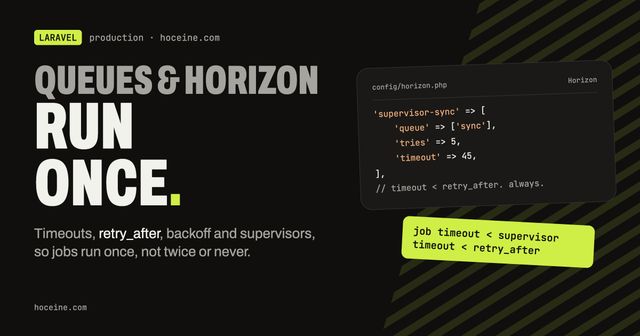
Supervisor Configuration

ini
[program:laravel-worker]
process_name=%(program_name)s_%(process_num)02d
command=php /var/www/current/artisan queue:work redis --sleep=3 --tries=3 --max-time=3600
autostart=true
autorestart=true
stopasgroup=true
killasgroup=true
user=forge
numprocs=8
redirect_stderr=true
stdout_logfile=/var/www/shared/storage/logs/worker.log
stopwaitsecs=3600

Horizon for Advanced Queues

bash
# Install Horizon
composer require laravel/horizon

# Supervisor for Horizon
[program:horizon]
process_name=%(program_name)s
command=php /var/www/current/artisan horizon
autostart=true
autorestart=true
user=forge
redirect_stderr=true
stdout_logfile=/var/www/shared/storage/logs/horizon.log
stopwaitsecs=3600

Health Checks

Health Check Endpoint

php
// routes/web.php
Route::get('/health', function () {
    $checks = [
        'database' => false,
        'cache' => false,
        'queue' => false,
    ];

    try {
        DB::connection()->getPdo();
        $checks['database'] = true;
    } catch (\Exception $e) {}

    try {
        Cache::put('health_check', true, 10);
        $checks['cache'] = Cache::get('health_check') === true;
    } catch (\Exception $e) {}

    try {
        Queue::size('default');
        $checks['queue'] = true;
    } catch (\Exception $e) {}

    $allHealthy = !in_array(false, $checks, true);

    return response()->json([
        'status' => $allHealthy ? 'healthy' : 'unhealthy',
        'checks' => $checks,
        'timestamp' => now()->toISOString(),
    ], $allHealthy ? 200 : 503);
});

Monitoring Integration

php
// app/Providers/AppServiceProvider.php
public function boot()
{
    if (app()->isProduction()) {
        // Log slow queries
        DB::listen(function ($query) {
            if ($query->time > 1000) {
                Log::warning('Slow query', [
                    'sql' => $query->sql,
                    'time' => $query->time,
                ]);
            }
        });

        // Report exceptions to external service
        $this->app['log']->listen(function ($event) {
            if ($event->level === 'error') {
                // Send to Sentry, Flare, etc.
            }
        });
    }
}

Rollback Procedures

Quick Rollback

bash
#!/bin/bash
# rollback.sh

CURRENT_LINK="/var/www/current"
RELEASES_DIR="/var/www/releases"

# Get previous release
PREVIOUS=$(ls -t $RELEASES_DIR | sed -n '2p')

if [ -z "$PREVIOUS" ]; then
    echo "No previous release found!"
    exit 1
fi

echo "Rolling back to: $PREVIOUS"

# Swap symlink
ln -sfn "$RELEASES_DIR/$PREVIOUS" $CURRENT_LINK

# Reload PHP-FPM
sudo systemctl reload php8.3-fpm

# Restart queues
php $CURRENT_LINK/artisan queue:restart

echo "Rollback complete!"

Database Rollback

bash
# Rollback last migration
php artisan migrate:rollback --step=1

# Rollback to specific batch
php artisan migrate:rollback --batch=5

SSL and Security

Force HTTPS

php
// app/Providers/AppServiceProvider.php
public function boot()
{
    if (app()->isProduction()) {
        URL::forceScheme('https');
    }
}

Security Headers

php
// app/Http/Middleware/SecurityHeaders.php
public function handle($request, $next)
{
    $response = $next($request);

    $response->headers->set('X-Frame-Options', 'SAMEORIGIN');
    $response->headers->set('X-Content-Type-Options', 'nosniff');
    $response->headers->set('X-XSS-Protection', '1; mode=block');
    $response->headers->set('Referrer-Policy', 'strict-origin-when-cross-origin');
    $response->headers->set('Permissions-Policy', 'camera=(), microphone=(), geolocation=()');

    if (app()->isProduction()) {
        $response->headers->set(
            'Strict-Transport-Security',
            'max-age=31536000; includeSubDomains'
        );
    }

    return $response;
}

Deployment Checklist

Before Deployment

  • All tests passing
  • Code reviewed
  • Dependencies updated
  • Environment variables set
  • Database backup taken
  • Rollback plan ready

During Deployment

  • Maintenance mode if needed
  • Pull latest code
  • Install dependencies
  • Run migrations
  • Clear caches
  • Restart queue workers

After Deployment

  • Health check passing
  • Monitor error logs
  • Verify critical features
  • Check queue processing
  • Monitor performance

Conclusion

Zero-downtime deployments require atomic symlink swaps, proper database migration strategies, and queue worker management. Always have a rollback plan and monitor your application after every deployment.


Resources

Related
Scroll to discover more...