After PHP2Shell: Should You Leave PHP, and Is Laravel Safer Than Plain PHP?
An honest answer from a Laravel developer. Why PHP2Shell is not a reason to switch languages, what Laravel protects you from and what it cannot, and the checklist that actually keeps a PHP app safe.
 Hoceine El Idrissi5 min read
After PHP2Shell: Should You Leave PHP?
After PHP2Shell, two questions kept coming up in my messages and in every PHP community I follow:
- Is PHP now too dangerous to build on?
- Is Laravel safer than writing plain PHP?
Short answers: no, and yes, but not against this bug. Here is the long version.
Question 1: should you leave PHP?
Look at what else broke in the same week:
| Runtime or tool | Worst bug this week | Login needed? |
|---|---|---|
| PHP | 9.2, code execution | No |
| Java (Oracle, GraalVM) | 9.1, TLS trust broken | No |
| Node.js | out-of-bounds write in Brotli | No |
| GitLab (Ruby) | 10.0, code execution | No |
| NGINX (in front of all of them) | 9.2, code execution | No |
If one critical runtime bug were a reason to leave a language, you would have to leave Java and Node in the same week, and Ruby the week before. Every runtime written in C or C++ (PHP, Node, Python, Ruby, the JVM's native parts) has memory bugs. They get found, fixed and shipped.
What actually decides your risk is not the language. It is these three things:
- Are you on a supported version? PHP 8.2 to 8.5 got a fix within hours. PHP 7 and 8.1 got nothing. Node 20 got nothing for its Brotli bug either. Same lesson, different language.
- How fast can you deploy a runtime update? Minutes with Docker or a managed platform. Days or never with a hand built server nobody wants to touch.
- What runs in front of PHP? Request size limits, a WAF and a patched NGINX reduce the window.
Rewriting a working product in Go or Rust to avoid one interpreter bug trades a one hour patch for a year of rewrite risk. It also brings new runtimes with their own bug history. Go needed its own fix this very week for the eMudhra certificates.
There are real reasons to pick another language for a project: the team's skills, the kind of workload, the ecosystem you need. PHP2Shell is not one of them.
Question 2: is Laravel safer than plain PHP?
It depends on which layer you mean.
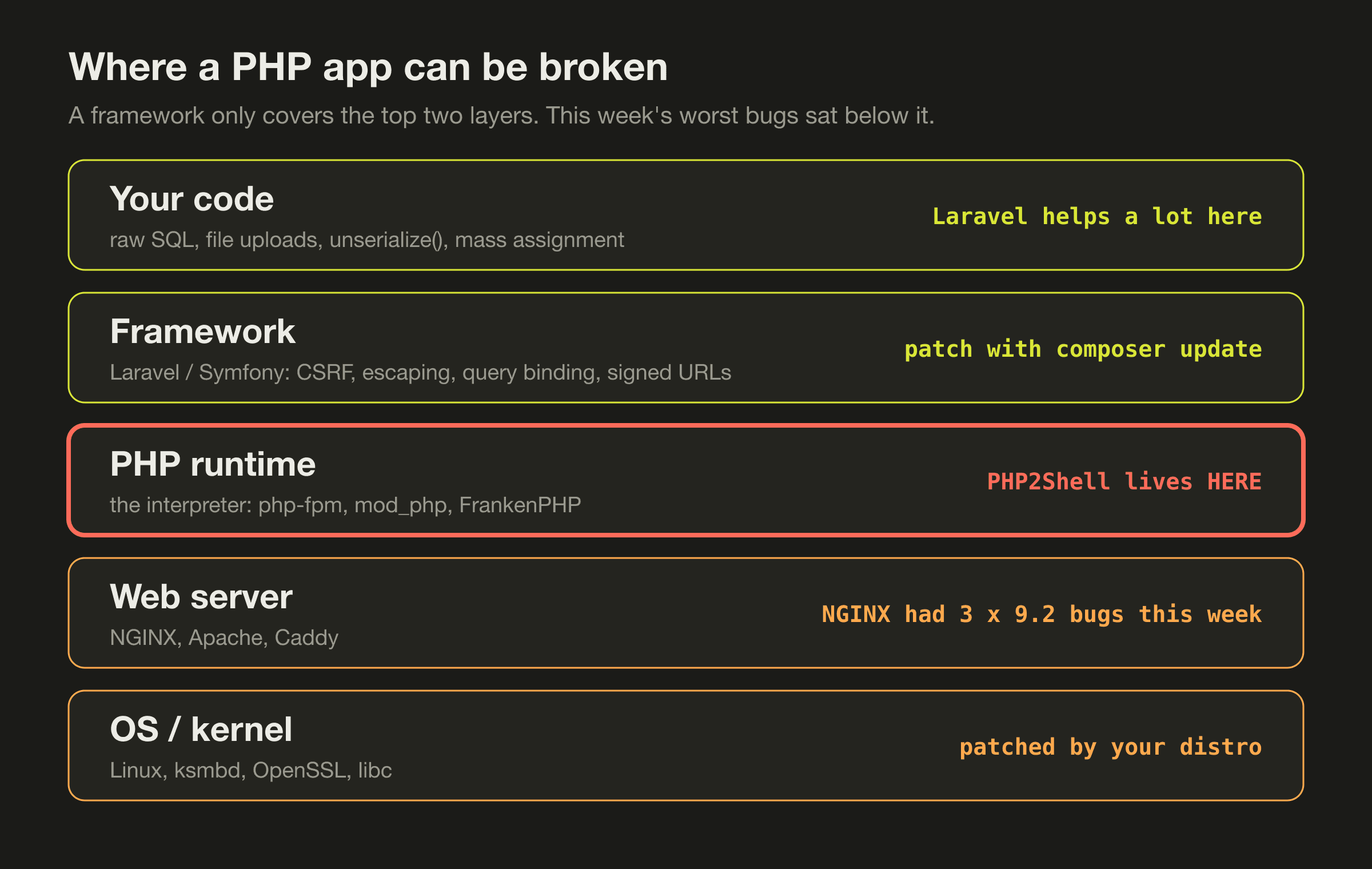
Against PHP2Shell, Laravel does not help at all. The bug sits in the interpreter. On Apache
mod_php the attack completes before public/index.php runs. No middleware, no route, no
validation ever sees the request. A fully updated Laravel app on PHP 8.1 is more exposed than a plain PHP
script on PHP 8.4.27. Upgrading Laravel with composer update changes nothing; upgrading PHP fixes
it.
Against the bugs that hack most PHP sites, Laravel helps a lot. Year after year, PHP sites get broken through application code far more often than through the interpreter: SQL injection, XSS, missing CSRF checks, insecure uploads, weak password storage. That is the layer where a framework earns its keep:
| Common hole | Plain PHP, by default | Laravel, by default |
|---|---|---|
| SQL injection | you must remember prepared statements | Eloquent and the query builder bind values |
| XSS | you must call htmlspecialchars everywhere | Blade {{ }} escapes output |
| CSRF | you build tokens yourself | VerifyCsrfToken on every web route |
| Passwords | easy to store MD5 or SHA1 | Hash::make uses bcrypt or argon2 |
| Mass assignment | not a concept | $fillable and $guarded |
| Signed links, encryption, rate limits | DIY | built in |
Laravel does not make you safe; it makes the safe path the default path. You can still write
DB::raw($request->input('sort')) or {!! $comment !!} and undo all of it.
So the honest answer: Laravel makes your code safer. It makes your runtime exactly as safe as the PHP version under it.
What actually protects a PHP app
This is the checklist I now apply to every Laravel project I build or inherit:
- Stay on a supported PHP branch. Today that means 8.2 or newer. Put the end-of-life date for your branch in the calendar. 8.2 leaves security support at the end of 2026.
- Make PHP updates boring. Pin the base image (
php:8.4-fpm), rebuild weekly, and let CI redeploy. Or use a platform that patches the runtime for you, like Laravel Cloud did this week. - Restart what you patch. FPM pools, Octane, FrankenPHP and queue workers keep the old binary in memory until they restart.
- Turn off what you do not use. If you never show upload progress, set
session.upload_progress.enabled = 0. Dropmod_phpfor PHP-FPM behind NGINX. - Limit the blast radius. Run PHP as a non-root user, keep
.envout of the web root, give the database user only the grants it needs, and keep secrets you can rotate in minutes. - Watch the right feeds. Subscribe to PHP's announcements, the Laravel security list, your
distro's security tracker and CISA's KEV catalog. Run
composer auditin CI. - Patch the layers around PHP too. NGINX, OpenSSL, the kernel and your Git server all had critical bugs this month.
My take
I build with Laravel and I am staying with it. PHP2Shell was serious, the leak made it messy, and the patch window was short. But PHP shipped fixes for every supported branch the same day the details went public, and platforms like Laravel Cloud patched customers before most of them woke up.
The scary number from this week is not 9.2. It is the roughly half of PHP websites still on versions with no fix. That is not a PHP problem, it is a maintenance problem, and it follows you to any language you switch to.
If you want help checking or upgrading a PHP or Laravel server, get in touch.