Laravel Omega: What We Actually Know About Laravel for Rust
Taylor Otwell is teasing Omega, a Laravel-flavored framework written in Rust. I went through the posts, the replies and the one public repo, inertia-omega, to separate what is confirmed from what is guesswork.
 Hoceine El Idrissi11 min read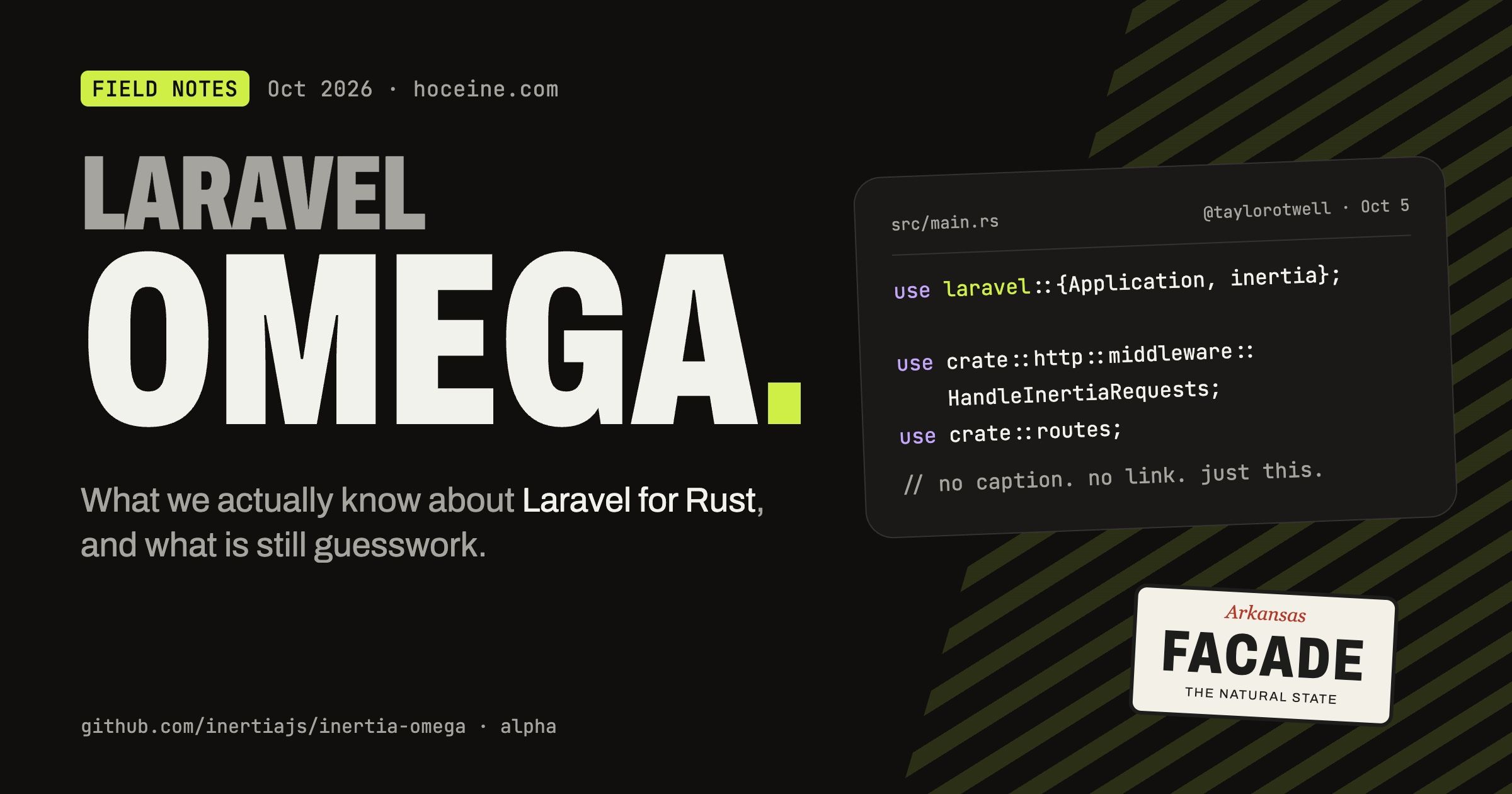
Laravel Omega: What We Actually Know About Laravel for Rust
On Monday, October 5, Taylor Otwell posted three lines of code and nothing else:
use laravel::{Application, inertia};

use crate::http::middleware::HandleInertiaRequests;
use crate::routes;
No caption. No link. Just Rust, typed in that monospace Unicode font people use when they want a tweet to look like a terminal. It got 85k views and 680+ likes in a day, and the replies filled up with one word: Omega.
I write Laravel for a living. I have never written a line of Rust. So this post is a Laravel developer reading Rust for the first time, which is probably exactly who Omega is for. None of the Rust code below is mine: it is quoted from Taylor's post and from the public repo, with links. I zoomed into those three lines like everyone else, then went looking for anything solid. This post is what I found, sorted into "confirmed", "very likely" and "people are guessing".
Short version: there is no Omega release, no docs, no landing page. But there is a public repository under the Inertia.js organisation, with Taylor's name on the commits, and it tells us a lot.
The timeline
Everything public so far, in order. All times UTC.
| Date | What happened | Source |
|---|---|---|
| Jul 16 | Taylor posts "from @laravelphp to @laravel ✨". A reply asks if a Rust port is confirmed. Nobody answers. | X |
| Oct 5, 12:49 | First commit of inertiajs/inertia-omega on GitHub. | GitHub |
| Oct 5, 14:35 | Taylor posts the use laravel::{Application, inertia}; snippet. | X |
| Oct 5, 15:29 | Punyapal Shah quotes it: "I told you; now cannot wait to use Omega: Laravel for Rust 💪". This is where the name spreads. | X |
| Oct 5, 21:39 | Taylor: "Ready for the Rust meet-up 😌". The photo is his orange Lamborghini. The plate says FACADE. | X |
| Oct 7 | Taylor: "Omega before GTA6 😭". | X |
| Oct 8 | Laravel Daily's newsletter goes out titled "The Future of Laravel is... Rust?" | archive |
| Oct 14 | inertia-omega bumps to "Require Rust 1.99". | commits |
| Oct 16 | Latest push, co-authored by Taylor Otwell. | commits |
Notice the first two rows on October 5. The repo went up about two hours before the tweet. That is not a coincidence I am willing to ignore.
A licence plate that says FACADE, posted on the same day as a Rust teaser, captioned "Rust meet-up". If you know Laravel, you know what a facade is. I don't think Taylor picked that photo at random.
Reading the three lines like a Laravel dev
Each line in that snippet maps to something you already have in a Laravel app.
use laravel::{Application, inertia}; A crate literally named laravel. Application is
the same name as Illuminate\Foundation\Application, the container that boots everything.
And inertia is exported from the framework itself, not pulled in as a third-party package.
That tells me Inertia is a first-class citizen, like it is in the official starter kits.
use crate::http::middleware::HandleInertiaRequests; In Rust, crate:: means "this
project". So the user's app has a folder http/middleware/ with a file defining
HandleInertiaRequests. That is app/Http/Middleware/HandleInertiaRequests.php, the exact
file every Laravel + Inertia app has. The folder structure survived the language change.
use crate::routes; A routes module in the app. Same idea as routes/web.php.
So the shape is: a Laravel skeleton, in Rust, where your app code lives in your crate and the
framework lives in laravel. That is the confirmed part, and it is already more than I
expected.
The repo that isn't a rumour: inertia-omega
inertiajs/inertia-omega is public, MIT,
marked ALPHA, and at the time of writing has 9 commits and around 110 stars. Its
description: "The Inertia.js server-side protocol for Rust, with a framework-agnostic core
and an Axum adapter."
A few details that matter:
- It is called
inertia-omega, but you import it asinertia. TheCargo.tomlsets[lib] name = "inertia". The README links to alaravel/omega-workspacerepo for setup. That repo returns a 404 for me, so it is private. There is the "Omega" name, on an official org, pointing at a private Laravel workspace. - It mentions a sibling crate called
laravel-omega-vite, which renders asset tags "like Laravel's@vite". Also not public yet. - Taylor is a contributor. Recent commits carry
Co-authored-by: Taylor Otwell <taylor@laravel.com>. - It is a port, not a rewrite from scratch. The README says the props resolver and the protocol rules are ports of inertia-laravel, and credits Veer for the adapter design.
- It is built heavily with AI agents. Commits carry Amp thread IDs and the first commit is co-authored by Claude. Make of that what you will. I find it interesting that the creator of one of the biggest PHP frameworks is porting it with agents doing a lot of the typing.
What the code looks like
A handler, straight from the README:
async fn show(inertia: Inertia, Path(id): Path<u64>, State(db): State<Db>) -> inertia::Response {
    let user = db.find_user(id).await;

    inertia.render("Users/Show", props! {
        "user" => user,
        "activity" => inertia::defer(move || async move { db.activity_for(id).await }),
    })
}
If you have written Inertia::render('Users/Show', [...]) with an Inertia::defer() prop,
you can read that without knowing any Rust. That is clearly the point.
Validation and redirects feel familiar too:
async fn store(inertia: Inertia, Json(form): Json<NewUser>) -> HttpResponse {
    let mut errors = ValidationErrors::new();

    if form.name.trim().is_empty() {
        errors.add("name", "The name field is required.");
    }

    if !errors.is_empty() {
        return inertia.back_with_errors(errors);
    }

    create_user(form).await;
    inertia.flash("toast", "User created!");

    inertia::redirect("/users")
}
Yes, that error message is word for word Laravel's validation.required string.
And testing, modelled on assertInertia:
AssertablePage::from_body(&body)
    .component("Users/Index")
    .has_count("users", 3)
    .equals("users.0.name", "Taylor")
    .missing("users.0.password")
    .deferred("default", &["stats"])
    .flash("toast", "Saved!");
The cheat sheet they wrote for us
The README has a "Coming from Laravel" table. Here is a trimmed version, because it is the best preview of how Omega wants to feel:
| Laravel | Rust (inertia-omega) |
|---|---|
Inertia::render('Users/Index', [...]) | inertia.render("Users/Index", props! { .. }) |
Inertia::defer(fn () => ..)->group('x') | inertia::defer(|| async { .. }).group("x") |
Inertia::merge(..)->matchOn('id') | inertia::merge(..).match_on("id") |
Inertia::once(fn () => ..)->until(..) | inertia::once(|| async { .. }).until(..) |
HandleInertiaRequests::share() | Config::share or inertia.share(..) in a middleware |
back()->withErrors($errors) | inertia.back_with_errors(errors) |
Inertia::flash('key', $value) | inertia.flash("key", value) |
$response->assertInertia(fn ($page) => ..) | AssertablePage::from_body(&body).. |
Not ported yet, per the README: Inertia DevTools, ProvidesInertiaProperties, component
name transformers, the ensure_pages_exist check, and Precognition.
Under the hood
Today the adapter targets Axum with tower-sessions. Feature flags let you turn pieces on and off:
| Feature | Default | What it adds |
|---|---|---|
axum | yes | The Axum adapter |
tower-sessions | yes | Sessions through tower-sessions |
ssr | yes | Server-side rendering over HTTP |
ssr-tls | no | HTTPS for the SSR gateway |
validator / garde | no | Turn those crates' errors into ValidationErrors |
It needs Rust 1.99 and the 2024 edition. SSR works the way it does in Laravel: a
public/hot file in development, bootstrap/ssr/app.js in production. Those paths are
Laravel paths. Again, not an accident.
Confirmed, likely, guessing
Let me be careful here, because a lot of posts this week blurred the line.
Confirmed
- Taylor is writing Rust that imports from a crate called
laravel, with Laravel's folder conventions. - A public, alpha, Laravel-team-backed Inertia server adapter for Rust exists and uses the "omega" name.
- A private
laravel/omega-workspaceand alaravel-omega-vitecrate exist (referenced in the README). - Taylor has used the word "Omega" himself ("Omega before GTA6").
Very likely
- Omega is the codename for a Laravel-style framework in Rust, and inertia-omega is the first piece shipped in public.
- Inertia + React/Vue/Svelte is the default frontend story, like the current starter kits.
- It sits on Axum and Tokio rather than building its own HTTP server, at least for now.
People are guessing
- That Omega replaces PHP Laravel. Nothing says that. Laravel 13.x shipped point releases the same week.
- A release date. "Before GTA6" is a joke, and GTA6 keeps moving anyway.
- Eloquent, queues, Blade, Artisan in Rust. Probably on the list, zero public evidence yet.
- One reply guessed it is a PHP-to-binary compiler written in Rust. The
use crate::http::…line is app code written in Rust, so I don't buy it.
The other "Laravel for Rust" projects
Omega is not the first attempt. The community has been building this for a while, and if you want to play with the idea today, these exist:
| Project | Built on | Notes |
|---|---|---|
| Kit | Inertia, React | Inertia + React first-class. Docs. Successor of the archived Ruskit. |
| Suprnova | hyper, SeaORM, Tokio | Fork of Kit, Auth::login, Cache::remember style APIs. Site. |
| Larust | Axum, sqlx, tower-sessions | Routing, ORM, validation, auth, CLI. Docs. |
| Rustlavel | Tokio only | Built from scratch, Eloquent-shaped ORM, Artisan-style CLI. |
| Renox | Axum, HTMX, Alpine.js | The "TALL in Rust" one. Ships as one binary. |
| portside-labs/laravel-rust | Tokio | Unofficial port aiming at Laravel 13 parity. Very new. |
There is also a candid DEV post, "I built a Laravel-like web framework for Rust, but nobody is using it yet", which is worth reading because it shows the real problem. The code is not the hard part. Docs, ecosystem and trust are. That is exactly the thing Laravel the company has and these projects do not.
Why would anyone want this?
My take, as someone who ships Laravel and has not shipped Rust. Take the Rust side with that in mind:
What Rust would buy you. One binary you scp to a server. No PHP-FPM, no OPcache tuning,
no "which extension is missing on prod". Type errors at compile time instead of in Sentry at
2 a.m. Long-running processes that don't need Octane tricks to stay warm. Those are the
reasons Rust people give.
What it would cost you. A new language for most of us, with compile times and a borrow
checker that Rust developers themselves warn newcomers about. And the biggest one, which I can
judge from the Laravel side: Laravel's magic is mostly runtime
magic. Facades, the container, Eloquent's __call, macros. Rust doesn't do runtime magic. You
get macros and traits instead. Looking at props! and the Inertia extractor, the team
seems to be translating the feel rather than the mechanism, and I think that is the right
call.
What I am watching for.
- An ORM. This is where Rust frameworks live or die. Eloquent is the reason half of us stay.
- Whether
php artisan make:*becomescargo laravel make:*or something new. - How Forge, Vapor and Laravel Cloud treat a Rust app. Cloud deploying a single binary would be a big deal.
- Whether the Filament and Livewire world gets a story at all, or whether Omega is Inertia-only.
How to follow along
- Watch inertiajs/inertia-omega on GitHub. It is the only public code, and it moves every few days.
- Follow @taylorotwell on X. Every clue so far came from there.
- Keep an eye on laravel-news.com and the Laravel Daily newsletter.
- If you want to try the protocol now, clone inertia-omega, run
cargo test --all-features, and readtests/core.rs. It is the clearest view of how the core works without a web framework.
I will update this post when there is an official announcement. If you spot something I missed, a reply, a repo, a talk, send it to me and I'll add it with credit.
Sources
- Taylor Otwell,
use laravel::{Application, inertia};, Oct 5, 2026 - Punyapal Shah, "Omega: Laravel for Rust", Oct 5, 2026
- Taylor Otwell, "Ready for the Rust meet-up", Oct 5, 2026
- Taylor Otwell, "Omega before GTA6", Oct 7, 2026
- Taylor Otwell, "from @laravelphp to @laravel", Jul 16, 2026
- inertiajs/inertia-omega README, Cargo.toml and commit history
- inertiajs/inertia-laravel, the adapter it ports
- Inertia v3 protocol
- Laravel Daily, "The Future of Laravel is... Rust?", Oct 8, 2026